trureturing Open Math / Pitch
OPEN MATHEMATICS, IN PRACTICETRURETURING / THE OMEGA INSTITUTE
AN OPEN MATH COLLABORATION

Human intelligence.
Machine rigor.
An endless loop.

Start with human intuition. Explore with AI. Ground it in Lean. Let every checked result inspire the next question.

See how the loop works
THE RESEARCH CONTINUES
HUMAN DIRECTIONAn intuition worth exploringIntuition · questions · context
MACHINE DISCIPLINEA checkable contributionRead sources · construct arguments · check proofs
SHARED KNOWLEDGEA result to build onReview · reuse · the next question
01 → 02 → 03 →Every result feeds the next question.
01 / WHY WE BUILT THISTRURETURING / THE OMEGA INSTITUTE

Ideas begin as intuition.
We give them a precise place to stand.

We have more ideas about the world than we can make precise on our own.

AI helps us explore, find connections and read the relevant work. A convincing chain of thought still needs a proof.

LEAN FORMALIZATION

Explicit definitions.
Checked logic.
Reusable results.

Make one relation precise, then build on it.

  1. 01

    Bring an intuition

    A question, a pattern, a possible connection.

  2. 02

    Explore and read

    Agents find sources. We study the definitions and sharpen the question.

  3. 03

    Formalize and reuse

    State the assumptions. Check the proof. Preserve its dependencies.

  4. 04

    Help solve a real problem

    Work on someone else’s conjecture. Their feedback opens the next question.

A result becomes the next starting point.
A SHARED STARTING POINT

We connect knowledge through logical relationships, without partitioning it by discipline.

02 / CORRECTNESS AND CONTRIBUTIONTRURETURING / THE OMEGA INSTITUTE

The proof checks out.
What have we learned?

01 / CHECK THE REASONING

Is the reasoning correct?

Lean checks the proof under explicit definitions and assumptions.
02 / CHECK THE CONTRIBUTION

What does this add?

Renaming an existing theorem gives us a valid proof, but no added understanding.

INFORMATION ESCAPE

What differences do our current concepts fail to capture?

03 / THE CORE: DISTINCTIONTRURETURING / THE OMEGA INSTITUTE

Information escape:
differences our knowledge cannot see.

Different states give identical readings under every selected concept. Here, the catalog records degree sequence alone; it misses the difference between these graphs.

G₁

One six-cycle

Degree at every vertex2
Is it connected?Yes
G₂

Two triangles

Degree at every vertex2
Is it connected?No
INFORMATION ESCAPE

A real difference left uncaptured by our concepts.

x ≠ y,   ∀ i ∈ S, cᵢ(x) = cᵢ(y)

Formal escape definition ↗
04 / FROM DISTINCTION TO INFORMATION GAINTRURETURING / THE OMEGA INSTITUTE

A concept’s contribution:
the difference we lose without it.

THE SAME TWO GRAPHSTwo-state illustration
G₁
G₂
Degree sequence(2,2,2,2,2,2)(2,2,2,2,2,2)
2 / 2
escape rate in this two-state arena

Two different graphs; identical concept readings. Both ordered pairs escape.

Still-indistinguishable different pairs / all different pairs (ordered).

01 / A NEW NAME PRESERVES THE SAME BLIND SPOT

Any function of the same degree sequence still gives the same answer on both graphs.

02 / CAPTURE A PREVIOUSLY INVISIBLE DIFFERENCE

Triangle count separates these two graphs: 0 versus 2. It reads a relation the degree sequence lost.

03 / REMOVE IT: DOES THE DIFFERENCE ESCAPE AGAIN?

Remove triangle count: the two graphs become indistinguishable again. This isolates what that concept contributes beyond the rest.

δᵢ = ε(S ∖ {i}) − ε(S)

Contribution gain = escape without it − escape with it. Here: 1 − 0 = 1.
05 / HOW THE HARNESS ENFORCES THE METHODTRURETURING / THE OMEGA INSTITUTE

A harness for
correctness and contribution.

THE MECHANISMWHAT IT REQUIRESWHY IT MATTERS
01

References before proofs

Search literature, our library, pinned mathlib and third-party Lean libraries. Check assumptions; directly cite and apply exact matches.

Build on what is known.
02

Formal verification

State the claim and assumptions in Lean. Check the proof term and its axiom dependencies in the kernel.

Establish that it follows.
03

Reject bind-only

Expand aliases and local helpers. Reject mere instantiation, projection or repackaging as new mathematical content.

Require a substantive step.
04

Information escape

Count different states the catalog still cannot distinguish. Remove a contribution to test whether its distinction is supplied by the rest.

Identify its unique contribution.

Checked contributions return to the library with their sources and dependencies, ready for the next researcher or model.

Read the harness rules ↗
06 / IDEAS ARE BECOMING SHARED MATHEMATICSAS OF 01 OCT 2026

Real problems. Real papers.
A growing research conversation.

439Open-problem resolutions recorded
30+Researchers in dialogue and feedback
4Joint papers on arXiv
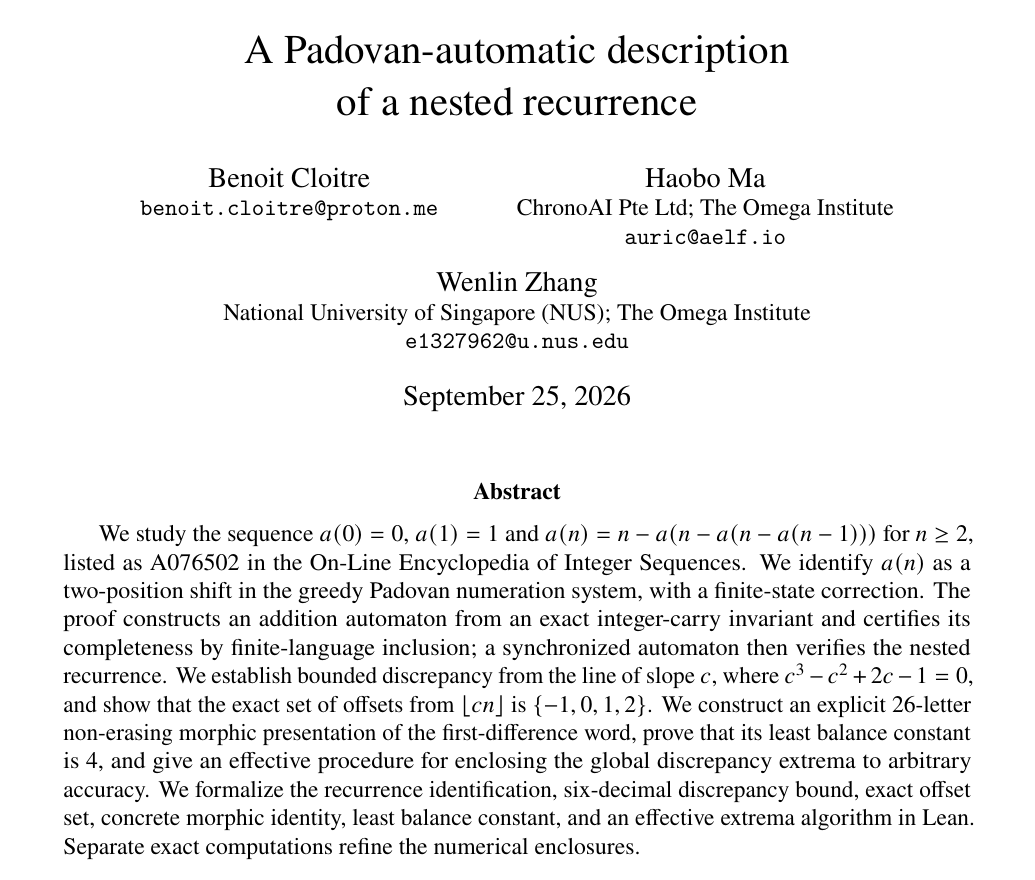
First page of the joint Padovan recurrence manuscript.
WITH BENOIT CLOITRE

A Padovan-automatic description of a nested recurrence

A counterexample grew into a joint theorem, independent verification and a reusable Lean archive.

arXiv:2609.33421 ↗
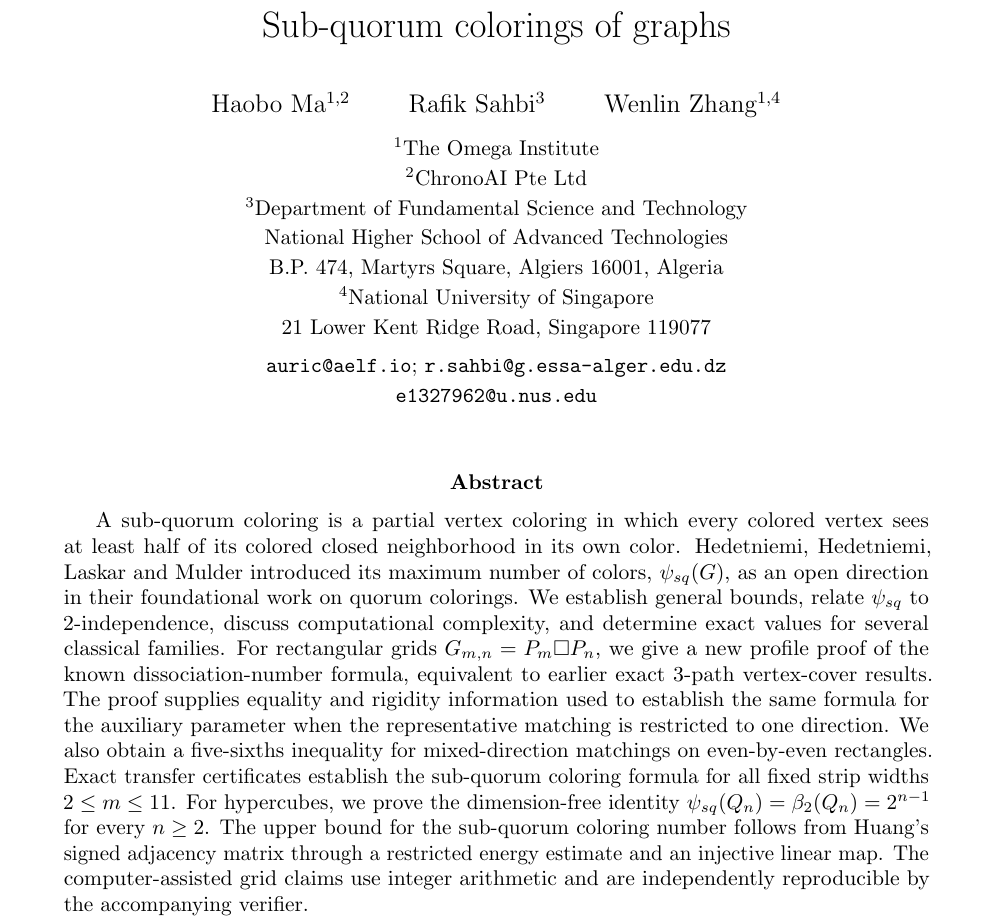
First page of Sub-quorum colorings of graphs, arXiv version 3.
WITH RAFIK SAHBI

Sub-quorum colorings of graphs

From a formal hypercube proof to grid certificates, structural bounds and a shared paper.

arXiv:2609.25128v3 ↗
SAIR EQT2Official #1 · 200/200 in all four participations
NeurIPS 2026 Math-AI WorkshopAccepted for poster presentation

Cross-Engine Admission Contracts for Autonomous Formalization

Early work on our harness engineering.
07 / RESEARCH DIALOGUE AND RECOGNITIONAS OF 01 OCT 2026

Research, review and recognition

John M. CampbellOpenAIExplicit formulas and recursive information
Rafik SahbiUniversity of CarthageHypercube proof and uniform grid bounds
Benoit CloitreOEIS contributorPadovan recurrences and Conway-type dynamics
Louxin ZhangNational University of SingaporeMinimal word neighborhoods and classification
Reza NikandishJundi-Shapur University of TechnologyDimension six: 12 line colors, 15 subspace colors
Max A. AlekseyevGeorge Washington University · OEISTranslation-action proof and formalization feedback
Sanjaye RamgoolamQueen Mary, LondonGraph determinants and geometric multiplicities
Peter CameronUniversity of St AndrewsReviewed our semigroup counterexample
Robert IsraelUniversity of British Columbia · OEISProof feedback and OEIS update support
Wieb BosmaRadboud UniversitySumfree periodic families and finite certificates
R. VenkateshIndian Institute of ScienceHypergraph positivity and sunflower conditions
Václav KotěšovecOEIS · AsymptoticsHankel constants, precision checks and OEIS links
Joint research, proof review and feedback from researchers.Results and sources ↗
08 / GROWTH & FOUNDATIONSTRURETURING / THE OMEGA INSTITUTE

Connected knowledge.
A growing white-box model.

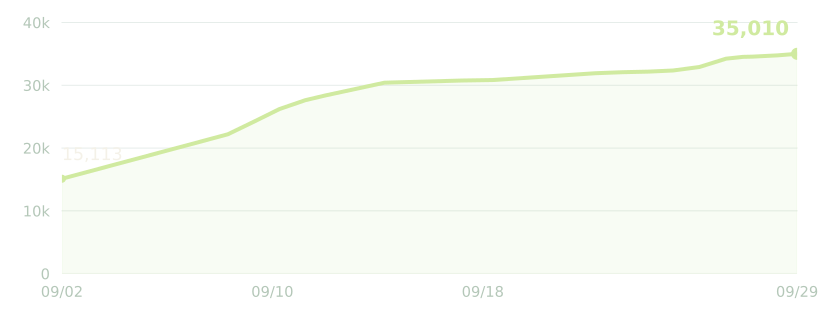
CUMULATIVE FROZEN THEOREM STATEMENTS
35,010
27 days · 2.32×+19,897 theorem statements
Frozen theorem statements grew from 15,113 on September 2 to 35,010 on September 29, 2026. Linear time and count axes, starting at zero.
Published source snapshots · September 2026 Counts & sources ↗
OUR RESEARCH THESIS

Mathematics is logical structure.

Shared logic · information escape

Relations of relations · recursion

Spacetime · holographic geometry
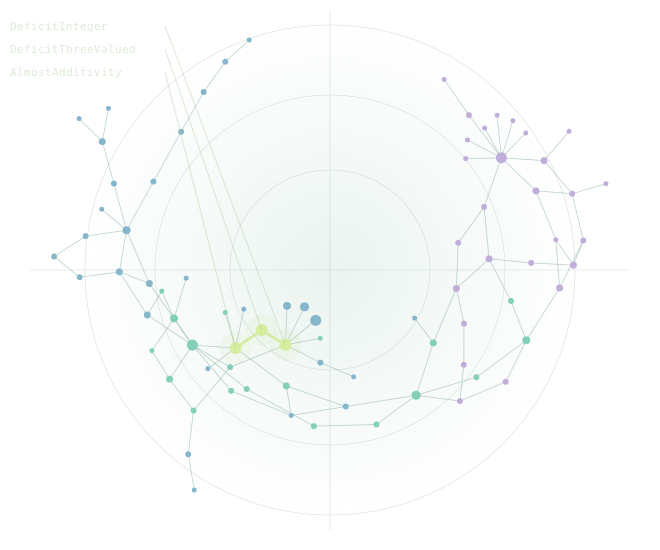
A shared library of nontrivial reasoning. Definitions, assumptions and proofs stay explicit.
A real dependency network of reusable formal modules.

Relations compose across disciplines. The dependency graph records how each checked result builds on others.

Explore the shared knowledge ↗
09 / OPEN SOURCE. OPEN CONTRIBUTION.TRURETURING / THE OMEGA INSTITUTE

You can start before you are an expert.
Learn by making one step precise.

01

A question

Give the research a direction.

02

An example

Expose a missing distinction.

03

An argument

Develop the next proof step.

04

A formalization

Make the reasoning checkable.

05

An independent check

Reproduce and strengthen the result.

10 / THE PEOPLE BEHIND THE WORKTRURETURING / THE OMEGA INSTITUTE

Building Trureturing.
Together.

AGENT INFRASTRUCTURE

Haobo Ma

CEO · Chrono AI

Builds infrastructure for agents to access tools, reuse skills and work together, with explicit checks on their progress.

PHYSICS + AI RESEARCH

Wenlin Zhang / Lexa

PhD student · National University of Singapore

Pursues de novo protein design through physics and AI, studying how structure, dynamics and energetics connect to biological function.

RESEARCH FOCUS

Protein design · Dynamics · Thermodynamics

We build the tools and pursue the research, learning how human–AI collaboration can produce knowledge that others can check and build on.

11 / THE SAIR COLLABORATION PROPOSALTRURETURING / THE OMEGA INSTITUTE

Connect OMM to this research loop.
More questions. More people building on the results.

MATHEMATICIANS + SAIR

Questions, expertise and open models

Researchers choose meaningful directions and review the mathematics. SAIR brings its open-model effort and research community.

TRURETURING

A white-box library and research harness

A connected library of explicit reasoning, with a harness to check, extend and reuse it through open contribution.

WHAT WE BUILD TOGETHER

An open contribution loop

  1. Real questions guide model reasoning.
  2. The harness requires correctness and substantive contributions.
  3. Researchers review the results and set the next direction.
  4. Each checked contribution extends the shared white-box model.
THE ASK

Connect OMM to our harness and develop a shared research track with mathematicians and open contributors.

12 / CHOOSE THE NEXT QUESTION TOGETHERTRURETURING / THE OMEGA INSTITUTE
LET’S BUILD THE NEXT COLLABORATION

Start with one idea.
Make one step precise.

Let OMM help more people turn intuition into checked, reusable knowledge. Every contribution gives the next person a place to begin.

THE FIRST WORKING SESSION
  1. 01Choose a question together
  2. 02Connect the model to the harness
  3. 03Open the work to contributors